How Often Should You Chemical Wash Your Aircond in Malaysia?
Find out the ideal frequency for aircond chemical wash in Malaysia's hot climate. Learn factors that affect cleaning frequency and signs your AC needs attention.
You know the frustration of turning on your air conditioner after a long day in KL traffic only to be met with weak, stifling airflow. We see this scenario play out constantly in homes across Puchong and Kuala Lumpur.
Many homeowners feel stuck between waiting for a total breakdown or paying for expensive servicing they might not actually need yet.
Our team believes in total transparency regarding when a unit truly requires a deep chemical clean versus a standard service.
Let’s look at the real data, the impact of our local humidity, and a practical schedule to keep your cooling costs down.
The Short Answer
Confusion often arises because “servicing” and “chemical washing” are two different procedures.
For most households in the Klang Valley, a deep chemical wash is not a monthly requirement.
Here is the breakdown we use for our clients:
- Light usage (Sleep only): Every 12 months.
- Normal usage (6-12 hours daily): Every 6-9 months.
- Heavy usage (WFH/Pets): Every 4-6 months.
This schedule assumes you are doing basic filter cleaning yourself in between professional visits.
Why “Standard” Advice Doesn’t Work Here
Generic guidelines often fail because they ignore Malaysia’s unique environmental factors.
1. The Humidity Factor (The Jelly Effect)
Our average relative humidity in the Klang Valley hovers between 74% and 86%.
High moisture levels combined with dust create a biological substance known as biofilm or “jelly.” This slime accumulates in the drainage tray and water pipes much faster here than in drier climates.
Ignoring this jelly buildup leads to the dreaded “water leaking” disaster that ruins wall paint.
2. Daily Usage Hours
The correlation between run-time and dirt accumulation is undeniable.
| Usage Profile | Hours/Day | Chemical Wash Frequency | Why? |
|---|---|---|---|
| Light | < 6 hours | 12 Months | Slow dust accumulation. |
| Normal | 6-12 hours | 6-9 Months | Standard bacterial growth cycle. |
| Heavy | 12+ hours | 4-6 Months | Rapid filter clogging and coil blockage. |
3. Location Specifics
Your specific neighborhood in Puchong or KL changes the equation significantly.
Near Construction or Main Roads?
- Dust levels are significantly higher due to ongoing development.
- Particulates from exhaust and cement dust coat the cooling coils rapidly.
- Action: Stick to a 4-6 month cycle.
High-Rise vs. Landed Property?
- Condos above the 10th floor generally experience less heavy dust but higher wind-blown pollen.
- Landed properties often face more insect intrusion and garden debris.
- Action: High-rise units can often extend intervals to 9-12 months if usage is moderate.
4. Kitchen Proximity
Cooking oil is the enemy of air conditioning efficiency.
Airborne grease gets sucked into the unit and creates a sticky layer on the evaporator fins. Dust then sticks to this grease like glue and cannot be removed with a simple vacuum or water spray.
Warning: If your unit is near the kitchen, a chemical wash is mandatory every 3-4 months to strip the grease.
Signs You Need Chemical Wash NOW
Waiting for a scheduled date is unwise if your unit is showing distress signals.
Watch for these immediate red flags:
- The “Black Flake” Test: Small black specks shooting out of the blower indicate mold has taken over the fan roller.
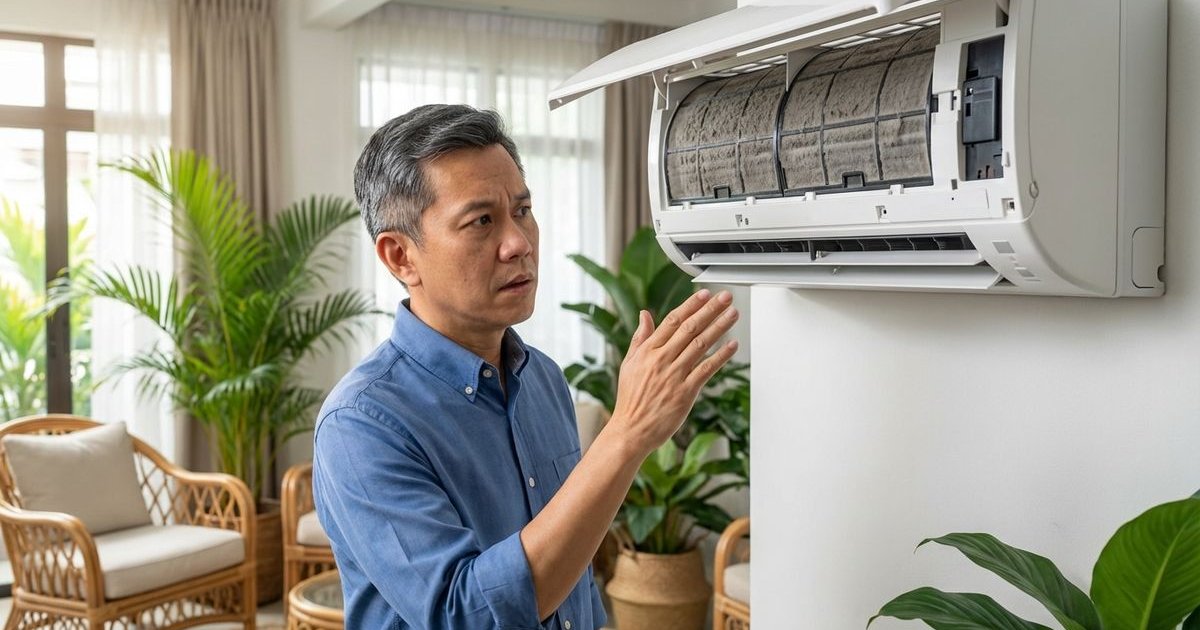
- Weak Airflow: Put your hand near the vent. If the air feels cold but the flow is weak (like a gentle breath), the coils are choked.
- The Locker Room Smell: A sour, vinegar-like odor means bacteria is breeding inside the cooling fins.
- Water Leaking: This usually means the drainage pipe is 100% blocked by the biofilm jelly mentioned earlier.
- Rising TNB Bills: A sudden spike in electricity costs often points to a compressor working double-time to push air through a dirty filter.
Any of these symptoms require immediate intervention to prevent hardware failure.
The True Cost of Skipping Maintenance
Many people skip chemical washing to save RM150, but the math rarely works out in their favor.
The Electricity Penalty
A dirty air conditioner is an energy vampire.
When airflow is restricted by 30%, the compressor must run longer to reach the set temperature.
- Fact: A clogged unit consumes 15-25% more electricity.
- The Cost: If your AC bill is usually RM150, that inefficiency costs you an extra RM37.50 per month.
- The Reality: Over six months, you waste RM225 on electricity—more than the cost of the cleaning itself.
Long-term Component Damage
Heat is the primary cause of compressor failure.
Restricted airflow prevents the refrigerant from absorbing heat effectively. This causes the compressor to overheat and eventually seize up. Replacing a compressor in Malaysia costs upwards of RM1,500.
Regular maintenance is asset protection, not just cleaning.
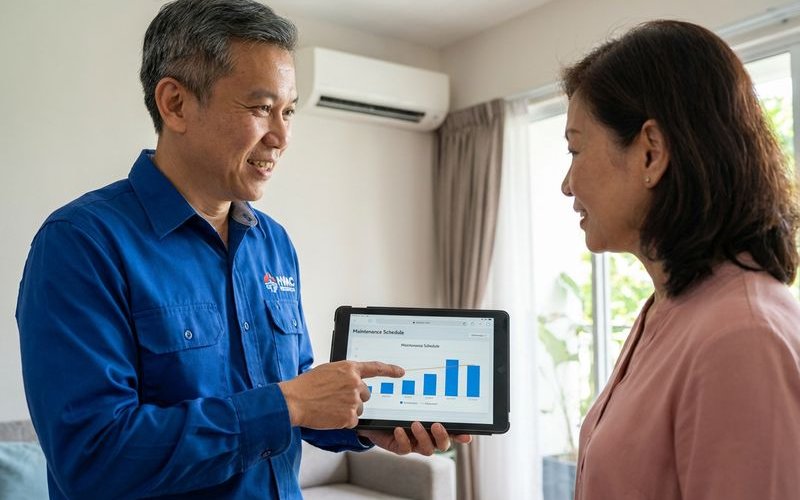
A Real-World Maintenance Schedule
We recommend this practical timeline for the average Malaysian family to balance cost and performance.
Monthly (DIY Task)
- Pull out the plastic filters: Wash them in the bathroom with water and mild soap.
- Dry completely: Shake them off before reinstalling.
- Visual Check: Shine a torch inside the blower to check for mold spots.
Every 6-9 Months (Professional Task)
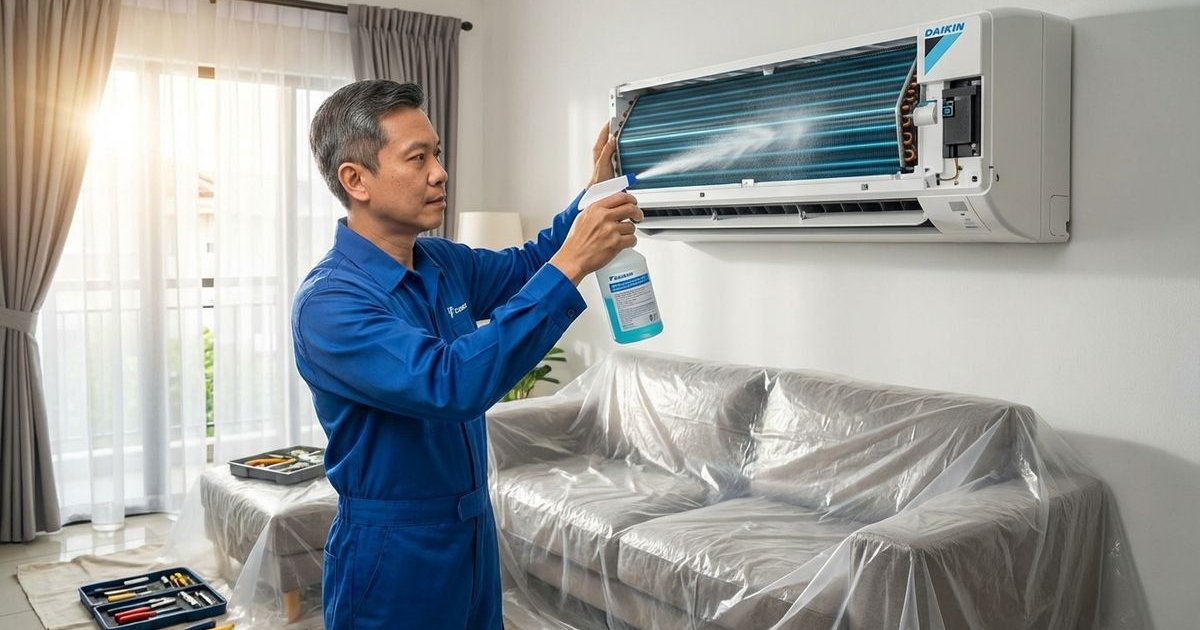
- Chemical Wash: Deep cleaning of the indoor evaporator coil and outdoor condenser.
- Drainage Flush: Vacuuming or flushing the drain pipe to remove jelly.
- Gas Pressure Check: Verification that refrigerant levels are optimal.
Annually (Full Inspection)
- Electrical Check: Tightening loose wire connections (a common fire hazard).
- Outdoor Unit Cleaning: Removing leaves and debris from the compressor unit.
A Note on “Hidden Costs”
We know many of you are wary of technicians who quote a low price and then demand more upon arrival.
A reputable service provider should include the following in a standard chemical wash price:
- Cleaning of indoor and outdoor units.
- Gas top-up (up to a certain PSI limit).
- Workmanship warranty (usually 30 days).
Warning: Be cautious of providers offering chemical washes for RM60-RM80. They often use extremely harsh acidic chemicals that strip the protective blue coating off your cooling fins to speed up the job. This permanently damages your unit’s efficiency.
Our Recommendation
For homeowners in Puchong and KL looking for a straightforward answer, we suggest:
- Chemical wash every 6 months as a baseline.
- Inspect filters monthly to gauge how fast dust is actually building up in your specific home.
- Call immediately if you see water or smell odors.
Save with Regular Maintenance
Consistent care pays for itself through lower TNB tariffs and extended equipment life.
- Efficiency: Restore 95% of original cooling power.
- Health: Remove mold spores that trigger sinus issues.
- Longevity: Push your unit’s lifespan past the 10-year mark.
Book Your Chemical Wash
Is your AC blowing warm air or smelling musty? Or are you just unsure if it’s time for a service? WhatsApp us and we’ll give you honest advice based on your situation.
Chemical Wash: From RM160/unit (FREE gas top-up included)
Related Service
Learn more about our chemical wash service